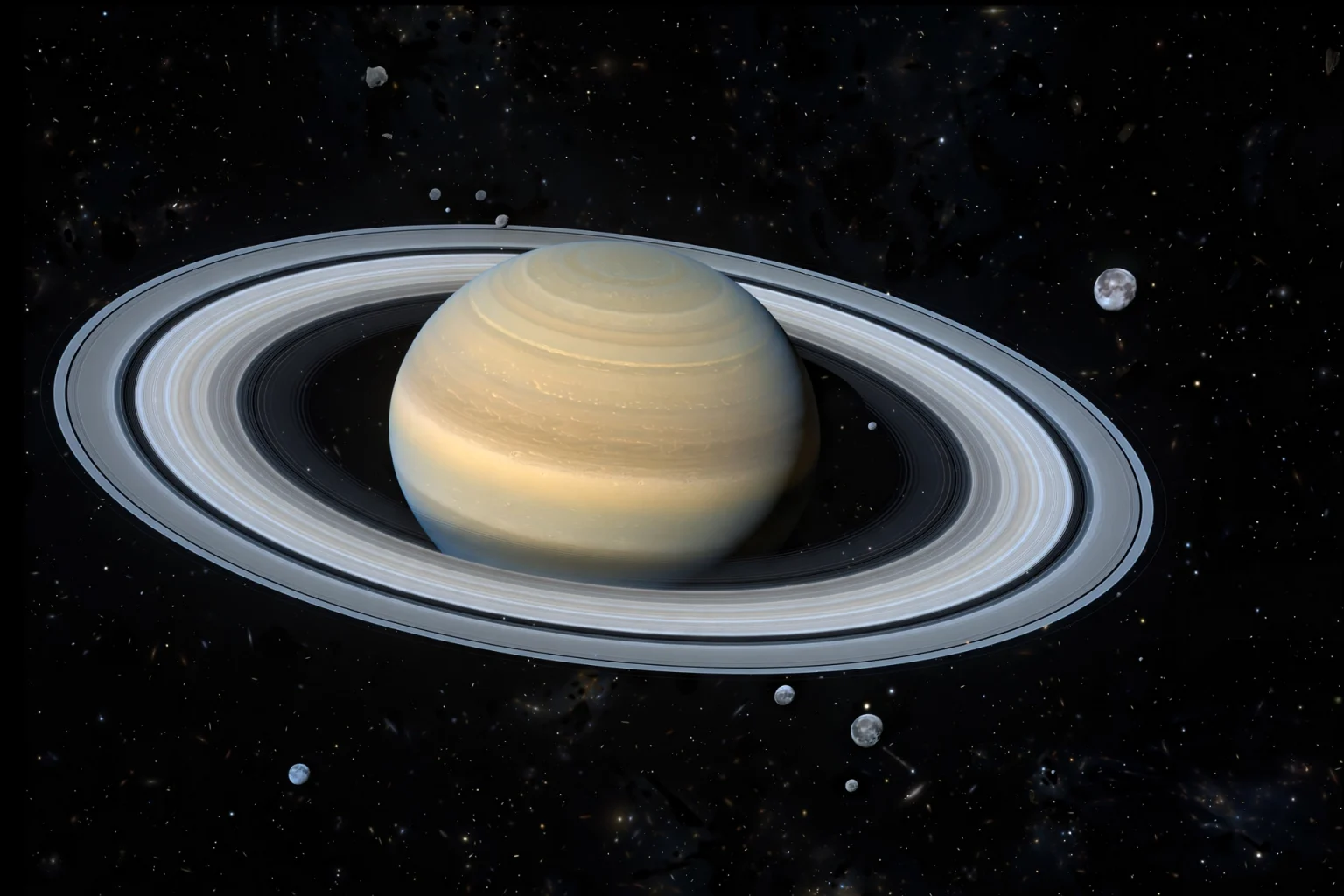

Saturn has pulled far ahead in one of astronomy’s friendliest contests. Researchers have confirmed 128 additional moons around the ringed planet, lifting its recognised total to 274. That single figure is larger than the moon counts of every other planet in the solar system put together, and it replaces the previous Saturn tally of 146, which had already looked hard to beat.
The announcement matters for more than bragging rights. Each tiny world is a clue about how the outer solar system was built, how often objects collided there, and how material orbiting a giant planet can be captured, broken apart and rearranged over billions of years. A census that nearly doubles in one step changes the questions scientists can ask about that history.
How the new moons were found
The discoveries come from a patient survey carried out with the Canada-France-Hawaii Telescope, which sits near the summit of Mauna Kea in Hawaii. Rather than spotting the moons in a single lucky image, the team gathered deep observations over several years and compared how faint points of light moved against the background stars.
The key method is known as shift and stack. Astronomers take many long exposures, shift each frame to follow Saturn’s expected motion, and then stack them together. Real moons travelling with the planet add up into a detectable signal, while random noise and unrelated background objects tend to wash out. The technique rewards patience: objects only a few kilometres wide, shining faintly at an enormous distance, can still emerge from the combined data.
Researchers linked to the University of British Columbia, including Dr Edward Ashton, played a central role in the analysis. Once the candidates had been tracked long enough to establish reliable orbits, they were formally recognised by the International Astronomical Union, the body responsible for official designations in astronomy.
Small, distant and travelling the wrong way
Do not picture 128 new versions of Titan or Enceladus. The newcomers are irregular moons: small, dark fragments only a few kilometres across, following distant orbits that are often steeply tilted compared with Saturn’s equator. Many travel retrograde, meaning they orbit in the opposite direction to Saturn’s rotation and to its large regular moons.
Those odd orbits are exactly what makes the objects scientifically valuable. A moon that formed alongside Saturn from the same disc of gas and dust would be expected to settle into a neat, orderly path. An irregular moon on a tilted, backwards loop looks far more like a visitor — an asteroid or comet fragment captured by Saturn’s gravity long after the planet itself had formed.
Debris from ancient collisions
The leading explanation for families of these moons is violent. A larger captured body may have been shattered in a collision, scattering pieces that still share related orbits today. Groups of the new moons appear to cluster in ways that support that idea, suggesting that some are fragments of bigger moons broken apart relatively recently in cosmic terms.
If that reading is correct, Saturn’s outer system is not a quiet museum. It is an active record of impacts, captures and break-ups, preserved because the cold and distance of the outer solar system change things slowly. Counting the fragments, and mapping precisely where each one travels, helps researchers work backwards towards the size and timing of the original collisions.
Readers who follow our science coverage can also explore our recent reporting on a diabetes monitoring trial, another story where careful measurement over time changed what researchers thought they knew.
Why the total keeps rising
Saturn did not suddenly gain 128 moons. They were always there; our telescopes and techniques simply became good enough to prove it. That distinction is important. The history of moon counts is partly a history of instrumentation, from early visual observers finding a handful of bright companions to modern digital surveys capable of stacking years of faint signals.
It also explains why astronomers are cautious about declaring any total final. Even deeper surveys may reveal still smaller fragments, and similar methods applied to Jupiter, Uranus and Neptune could revise their counts as well. For now, though, the gap is emphatic: at 274 confirmed moons, Saturn holds more known natural satellites than the rest of the planets combined.
What happens next
The next stage is detailed follow-up. Researchers will refine orbits, look for groupings that point to shared origins, and decide which objects deserve priority for further observation. Naming will follow the conventions overseen by the International Astronomical Union, a slower process than discovery itself.
For the casual observer, Saturn through a backyard telescope still shows the same bright jewel and a few prominent companions. The other 270 or so moons remain far beyond amateur reach. Yet knowing they are there changes the picture: the famous rings are only the most visible part of a vast, crowded and surprisingly violent system, and astronomers have just shown how much of it was hiding in plain sight.