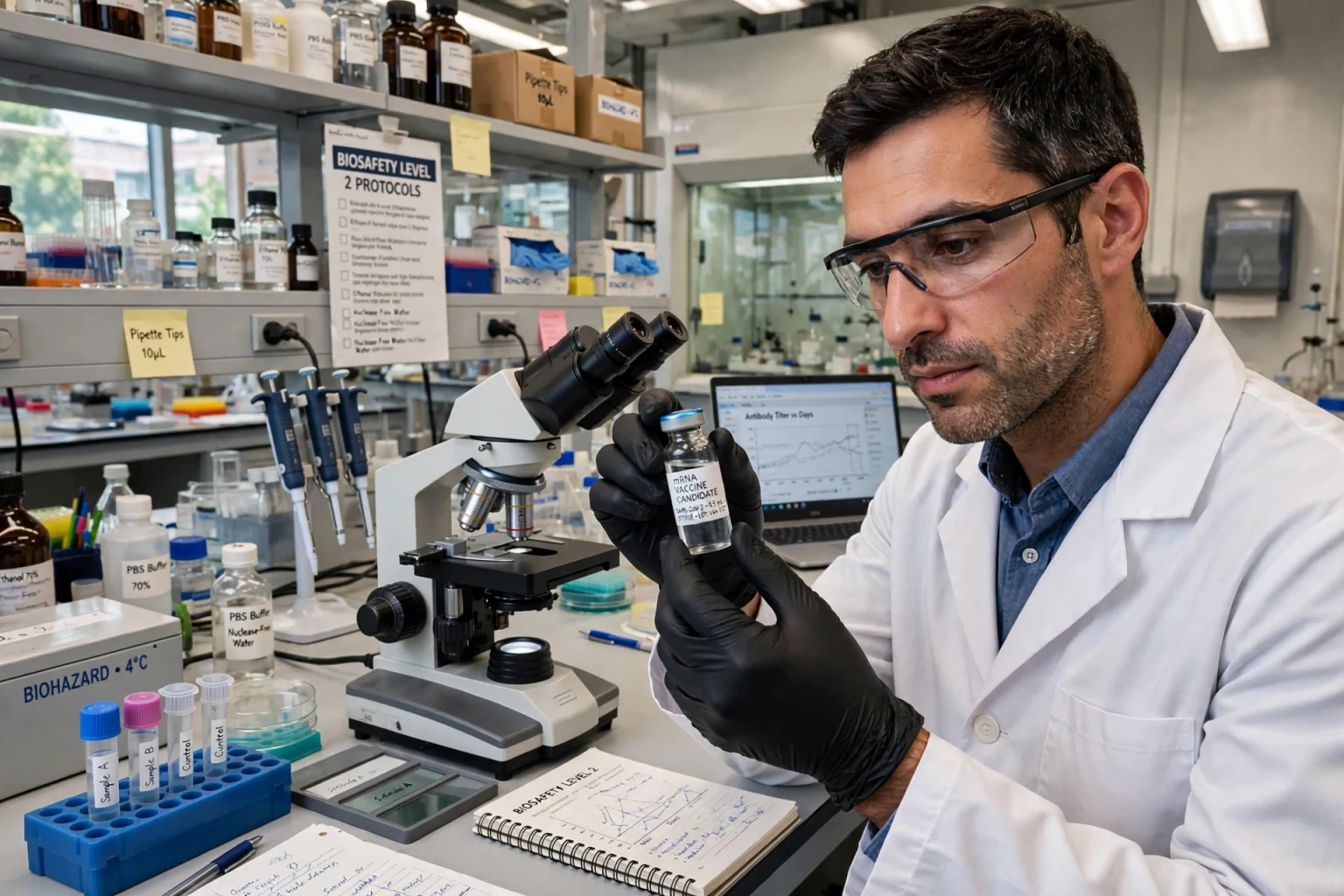

A vaccine built individually for each patient, using mutations taken from that person’s own tumour, has been successfully manufactured and given alongside immunotherapy in an early trial for recurrent ovarian cancer. The phase 1 study of the personalised neoantigen vaccine NeoVax, combined with the drug nivolumab, was published in Nature Medicine and focused first on a modest but essential question: can this complex treatment actually be made and delivered safely?
On that limited question, the researchers report an encouraging answer. Vaccines could be produced for patients in the study, treatment was given as planned, safety was judged acceptable, and laboratory tests showed immune responses. That is a meaningful step for a demanding idea — but it is not evidence of a cure, and the authors’ careful framing deserves to be kept intact.
A vaccine designed from one tumour at a time
NeoVax belongs to a class of treatments called neoantigen vaccines. When cancer cells accumulate mutations, some of those changes produce abnormal protein fragments — neoantigens — that do not appear in healthy tissue. In principle, the immune system can be taught to recognise those fragments as targets. Because every tumour carries a different set of mutations, the vaccine has to be personalised: tumour material is analysed, candidate neoantigens are selected, and a bespoke vaccine is manufactured for that individual.
That process is scientifically elegant and logistically hard. It requires tumour samples, sequencing, computational prediction of which fragments the immune system is most likely to notice, manufacturing to clinical standards, and delivery before the disease moves on. Demonstrating that the whole chain can work in real patients, within a real trial, is precisely what a phase 1 feasibility study is for.
The trial enrolled patients whose ovarian cancer had returned but remained platinum-sensitive, meaning it had previously responded to platinum-based chemotherapy and was considered likely to respond again. Background on ovarian cancer and its treatment is available from the National Cancer Institute.
Why nivolumab was added
The vaccine was not given alone. Patients also received nivolumab, a PD-1 immune checkpoint inhibitor. Drugs in this class work by releasing a brake on T cells, the immune cells responsible for attacking abnormal targets. The logic of the combination is straightforward: the vaccine tries to teach T cells what to look for, while the checkpoint inhibitor tries to stop those T cells being switched off when they find it.
Combination strategies are common in modern cancer research because single approaches often prove insufficient on their own. They also complicate interpretation. When two treatments are given together in a small early study, it becomes harder to say which component contributed what — another reason the results should be read as groundwork rather than verdict.
What the trial actually showed
The headline findings are deliberately narrow. First, feasibility: personalised vaccines could be manufactured and administered to the patients in the study. Second, safety: the treatment’s side effects were considered acceptable for this stage of testing. Third, immunogenicity: researchers detected T-cell responses consistent with the vaccine doing what it was designed to do — prompting the immune system to react against tumour-associated targets.
Each of those findings matters, and none of them amounts to proof that the treatment extends life or shrinks tumours reliably. Phase 1 trials are small by design, are not built to measure effectiveness, and usually lack the comparison groups needed to separate a treatment’s effect from the natural variation of disease. The full study is published in Nature Medicine, where the methods and limitations can be examined in detail.
Our earlier coverage of medical research, including a trial of continuous glucose monitors in type 2 diabetes, shows the same pattern: careful early studies establish whether an idea is practical and safe enough to justify bigger, harder tests.
What it means for patients today
For people living with recurrent ovarian cancer, the honest summary is hopeful but restrained. A personalised vaccine approach has cleared an early practical hurdle in a difficult disease, and the immune responses observed give researchers a reason to continue. Nothing in a phase 1 study changes standard treatment today, and anyone considering an experimental therapy should discuss trials and eligibility with their oncology team.
The road from here runs through larger studies. Those trials will need to test whether vaccine-induced immune responses translate into clinical benefit, how long any benefit lasts, which patients are most likely to respond, and whether the manufacturing process can be made faster and more scalable. Personalised medicine is, almost by definition, harder to scale than an off-the-shelf drug.
The bottom line
NeoVax plus nivolumab has passed an early test of feasibility and safety in platinum-sensitive recurrent ovarian cancer, with signs that the immune system responded as intended. That is real progress for a complex idea. It is also the beginning of the evidence, not the end of it — and reporting it that way respects both the science and the patients waiting for treatments that are proven, not just promising.